
AI-enabled virtual spatial proteomics from histopathology for interpretable biomarker discovery in lung cancer
2/8/20261 min read
For decades, histology has been the cornerstone of medical diagnosis. By examining stained tissue sections under a microscope, pathologists identify structural changes that signal disease—especially cancer. But what if a simple histology image could reveal much more than just morphology?
A recent study published in Nature Medicine shows that artificial intelligence (AI) can extract molecular-level information—such as protein expression—from routine histology images, without the need for additional laboratory tests.
From Morphology to Molecular Insight
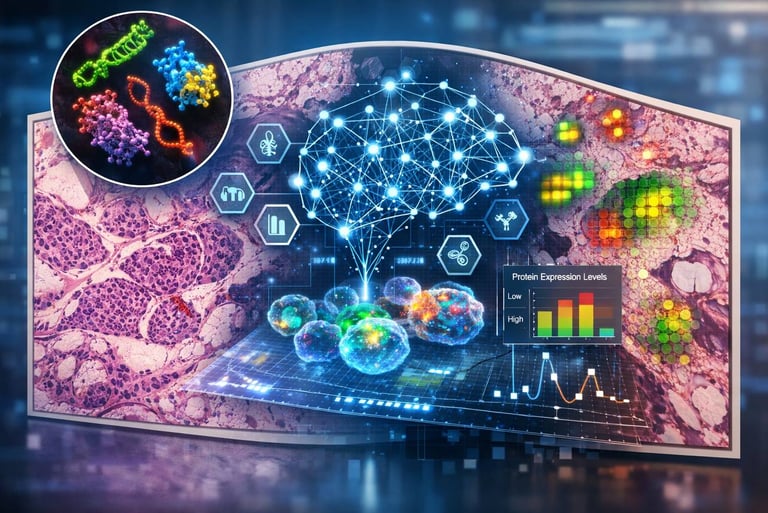
Traditionally, understanding the molecular profile of a tissue—like which proteins are active—requires expensive and time-consuming techniques such as immunohistochemistry or molecular assays. In this study, researchers trained a deep learning model to analyze standard H&E-stained histology slides and predict protein expression patterns directly from the images.
In other words, the AI learned to recognize subtle visual cues in tissue architecture that correlate with underlying molecular behavior—details that are invisible to the human eye.
Why This Is a Big Deal in Medicine
This approach could significantly transform diagnostic pathology:
• Faster diagnostics: Molecular insights could be obtained immediately from routine slides.
• Lower costs: Reduced reliance on additional molecular testing.
• More accessible precision medicine: Even labs without advanced molecular facilities could benefit.
The model demonstrated strong performance across large datasets, suggesting that histology images contain far more biological information than previously assumed.
Implications for Cancer Diagnosis
One of the most exciting applications is in oncology. Tumor behavior, prognosis, and response to therapy are often driven by molecular features. If AI can reliably infer these features from histology alone, clinicians may be able to make more informed treatment decisions earlier.
This bridges a critical gap between classical pathology and modern molecular medicine.
Challenges and the Road Ahead
Despite its promise, this technology still faces challenges. Models must be validated across diverse patient populations, tissue types, and clinical settings before routine clinical use. Transparency and interpretability of AI predictions are also crucial for trust in medical decision-making.
The Takeaway
This study highlights a paradigm shift: histology slides are no longer just images—they are rich data sources. With the help of AI, routine pathology could evolve into a powerful tool for molecular-level diagnosis, bringing us closer to truly integrated, precision medicine.

Follow
Contact
info@microlab.ink
© Microlab-copyright 2026
