
Modelling post-implantation human development to yolk sac blood emergence
2/1/20261 min read
Introduction
Early human embryonic development, especially the period immediately after implantation, remains poorly understood due to ethical and technical constraints. Direct observation of these stages in human embryos is extremely limited. In a recent study published in Nature, researchers present a stem-cell-based model that closely mimics early post-implantation human development, offering a new window into embryology research.
Study Overview
The researchers developed a three-dimensional structure called a heX-embryoid using human induced pluripotent stem cells (hiPSCs). These stem cells have the ability to self-organize, forming embryo-like architectures without genetic manipulation.
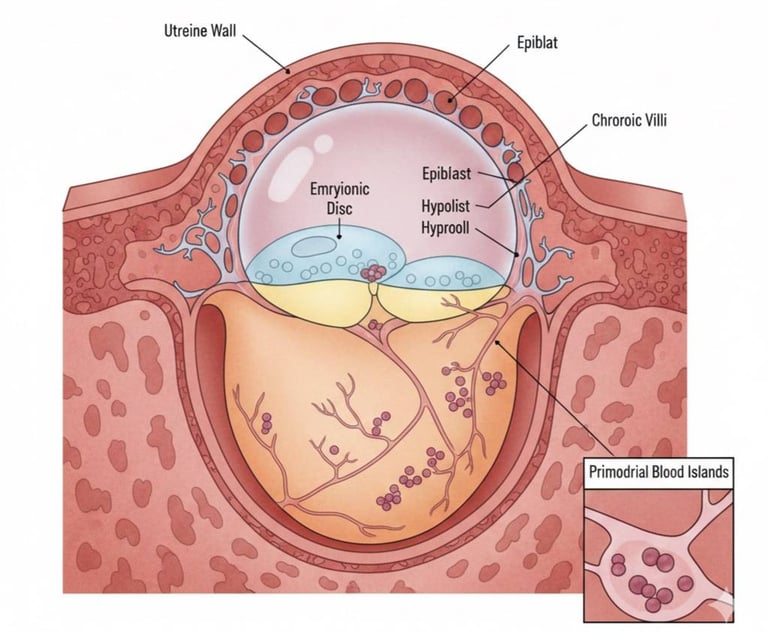
The resulting model recreates several hallmark features of early human embryos, including:
• A bilaminar embryonic disc
• Formation of an amniotic cavity
• Development of yolk sac–like tissues
These features are critical for normal embryonic patterning and organ development.
Key Findings
One of the most important discoveries in this study is the emergence of early haematopoiesis within the yolk sac–like compartment. The model produces cells resembling early blood progenitors, including:
• Erythroid lineage cells
• Myeloid lineage cells
• Megakaryocyte-like cells
This confirms that the embryoid model not only resembles the structure of early embryos but also replicates functional developmental processes.
Scientific and Clinical Significance
This model provides a powerful and ethically acceptable platform for:
• Studying human embryogenesis
• Investigating congenital abnormalities
• Understanding the origins of blood and developmental diseases
• Drug screening and toxicology testing
• Advancing research in regenerative medicine
Because the system is reproducible and scalable, it holds strong potential for widespread use in developmental biology research.
Summary
This Nature study demonstrates that stem cells can self-organize into embryo-like structures that closely mimic early post-implantation human development. The heX-embryoid model successfully reproduces both structural and functional aspects of embryogenesis, including early blood formation.
Conclusion
The development of heX-embryoids represents a major breakthrough in human embryology. By enabling detailed study of early developmental stages without the use of real embryos, this approach overcomes long-standing ethical and technical barriers. It opens new opportunities to better understand human development, disease mechanisms, and potential therapeutic strategies.

Follow
Contact
info@microlab.ink
© Microlab-copyright 2026
