
Virtual spatial transcriptomics for revealing genetics signatures from H&E images
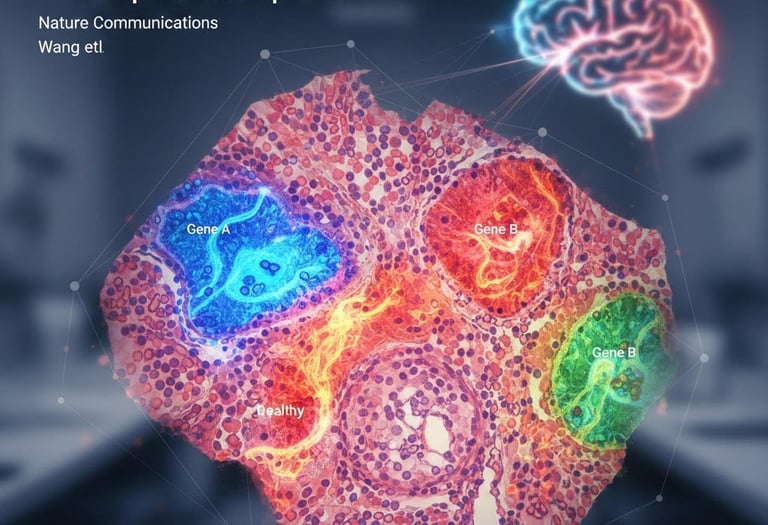
this study introduces a revolutionary AI model, "Virtual Spatial Transcriptomics," that predicts genetic activity directly from low-cost, standard H&E tissue images. By eliminating the need for expensive sequencing equipment, it enables any lab to identify aggressive cancer signatures quickly and affordably. This breakthrough paves the way for accessible Precision Medicine, allowing for personalized treatment plans based on a patient’s unique genetic map in seconds.
Xiyue Wang, Sen Yang ,...
12/25/20252 min read
The Future of Pathology: AI-Powered "Virtual" Gene Mapping
For over a century, the field of histology has relied on the same fundamental method: staining a thin slice of tissue and looking at it under a microscope to identify diseases like cancer based on their appearance (morphology).
However, a groundbreaking study recently published in Nature Communications is changing the game. Researchers have developed an AI model that can "see" what human eyes cannot—revealing the genetic activity of cells directly from a standard microscope slide.
The Challenge: Appearance vs. Reality
In modern medicine, knowing the genetic signature of a tumor is crucial for choosing the right treatment. But until now, mapping these genes (a process called Spatial Transcriptomics) has been incredibly expensive, time-consuming, and requires specialized equipment that most hospitals don't have.
The Breakthrough: Virtual Spatial Transcriptomics
The research team used Deep Learning to bridge this gap. They trained an AI on thousands
of tissue samples until it learned to recognize the subtle relationship between the
shape of a cell and its genetic function.
Here is why this is a massive leap forward:
• Instant Genetic Insights: By simply uploading a standard digital scan of a tissue slide
(H&E staining),the AI can "predict" which genes are active in specific areas of the tissue.
• Hidden Danger Detection: The AI can identify "hotspots" of genetic mutation in areas that
look perfectly healthy to a human pathologist.
• Democratizing Precision Medicine: This technology allows any clinic with a basic digital microscope to access high-level genetic data without spending millions on sequencing tech.
Why It Matters for Patients
This isn't just a cool tech update; it’s a lifesaver. By making genetic mapping fast and affordable, doctors can:
1. Diagnose aggressive cancers much earlier.
2. Predict how a patient will respond to immunotherapy.
3. Create a "Personalized Map" for surgery and treatment.
The Verdict
As we move further into the age of Digital Pathology, the line between "looking at a tissue" and "analyzing its DNA" is disappearing. This research proves that the visual patterns in our cells are a secret code—and we finally have the AI to crack it.
Source: "Virtual spatial transcriptomics for revealing genetic signatures from H&E images," Nature Communications (2024).

Follow
Contact
info@microlab.ink
© Microlab-copyright 2026
